How to Hem Activewear Without Killing the Stretch That Made It Work
Quick Answer: Stretch fabric needs a stitch that stretches with it. Use a twin needle on a domestic machine, a zigzag with a short width, or a coverstitch if a tailor has one - never a straight stitch, which snaps under the first deep squat. For leggings, cut only after wearing them once and marking the length while standing, because stretch fabric hangs differently on the body than on a table. Hemming tape is a genuine no-sew option for light alterations and lasts about ten washes.
You finally found tall leggings, and they are two inches too long.
Two inches is a fifteen-minute job that goes wrong in exactly one way, and it is entirely avoidable once you know what the stitch is doing.

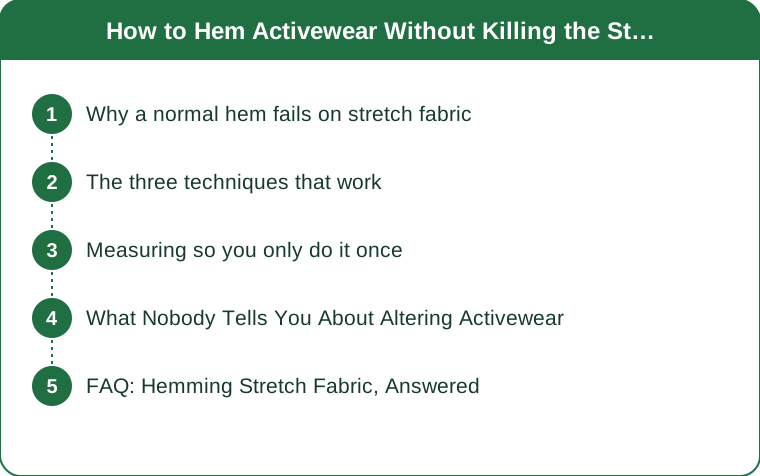
Why a normal hem fails on stretch fabric
A straight stitch has no give at all. When the fabric stretches around your calf during a squat or a lunge, the thread has nowhere to go, so it snaps - usually in several places at once, and usually the first time you wear it properly.
Four-way stretch makes it worse than two-way. Activewear knits stretch both across and along the fabric, so a hem is being pulled in two directions simultaneously, which is more than a rigid seam can absorb.
The needle matters as much as the stitch. A standard sharp needle punches through the knit loops and can cause runs or holes; a ballpoint or stretch needle pushes between the loops instead, which is a small change with a large effect on durability.
Thread choice is the third variable. Ordinary polyester thread has minimal stretch; a textured or woolly nylon thread in the bobbin adds meaningful give and is worth the small cost for anything you will train in.
And the fabric will curl at the cut edge, which is normal for a knit and is why every good technique folds the raw edge under rather than leaving it exposed.
The three techniques that work
Twin needle, on any domestic machine. It produces two parallel rows on the front and a zigzag underneath, which is what gives it stretch, and it is the closest a home machine gets to a factory finish. Fold the hem up once by about 2cm, press lightly with low heat, and stitch from the right side.
Narrow zigzag, if you have no twin needle. Set the width to about 1mm and the length to 3mm - almost a straight line but with just enough lateral movement to survive stretching. Less pretty, entirely functional.
Coverstitch, if you are paying a tailor. This is the industrial version and it is what the garment originally had. Worth asking for specifically, since not every alteration shop has the machine, and one that does will produce an invisible result.
Iron-on hemming tape as the no-sew option. Fuse it on low heat with a pressing cloth, and expect roughly ten washes before it starts to lift. Fine for a garment you wear occasionally, not for your main training leggings.
Whichever you choose, test on the offcut first. You are about to have a spare two inches of the exact fabric, which is the perfect place to discover that your machine’s tension needs adjusting.

Measuring so you only do it once
Wear them for at least an hour first. Stretch fabric relaxes with body heat and movement, and a garment measured straight out of the packet will end up shorter than you intended.
Mark while standing, in the shoes you will wear. Have someone pin it, or stand in front of a mirror and mark with tailor’s chalk. The difference between a standing and sitting measurement on a legging hem is around an inch.
Add 2cm below your mark for the fold, and cut there. The most common alteration mistake is cutting at the finished length and then having nothing to fold under.
Do one leg completely before touching the other, which sounds slow and prevents the single most annoying outcome in this whole process.
For sleeves, mark with your arm bent, since a sleeve measured straight is always short once you move.
And keep a record. Once you know that a particular brand runs two inches long on you, write it down - the alteration becomes predictable rather than exploratory.
What Nobody Tells You About Altering Activewear
Hemming often costs less than the price difference between standard and tall sizing, which changes the economics of shopping considerably. A ten-dollar alteration on a well-fitting standard-size garment can beat waiting for a tall version that may never come in the color you want.
Some things should not be altered. Compression leggings with graduated panels, anything with a printed placement design near the hem, and garments with reflective strips all lose something in the process.
Waistband alterations are a different and much harder job than hems. If the rise is wrong, altering it is rarely worth it - that is a sizing decision, not an alteration one.
A tailor who does bridal work is not automatically the right choice here. Ask specifically whether they work with performance knits and whether they have a coverstitch, because the skill sets barely overlap.
After 40 the length question often changes for a reason people miss: shoe choice shifts toward flatter footwear, which changes the required inseam by an inch or more from what worked in your thirties. Re-measure rather than assuming your old number still applies.
And check the fabric content before you commit. Anything above about 20 percent elastane is genuinely difficult to hem well at home, and is worth handing to someone with the right machine.
FAQ: Hemming Stretch Fabric, Answered
Can I hem leggings by hand?
Yes, using a herringbone or catch stitch worked loosely, which has enough give to survive stretching. It is slower but perfectly durable.
Do I need to finish the raw edge?
Knits do not fray, so no overlocking is required. Folding the edge under once is enough and keeps the hem from curling.
What needle should I use?
A stretch or ballpoint needle, size 75/11 or 80/12 for most activewear knits. A standard sharp needle causes runs.
Will hemming affect the compression?
At the hem only, and minimally, unless the garment has graduated compression panels - in which case leave it alone.
How much does a tailor usually charge?
Typically a modest flat fee for a simple hem, often less than the premium on tall sizing. Ask whether they have a coverstitch machine before booking.
Can I shorten sleeves the same way?
Yes, using the same techniques, but mark with your arm bent and expect to need slightly less shortening than you first think.
TL;DR:
- Straight stitches snap on stretch fabric - use a twin needle, a narrow zigzag, or a coverstitch, with a ballpoint needle.
- Wear the garment for an hour before measuring, mark while standing in the shoes you will wear, and cut 2cm below the mark.
- Woolly nylon in the bobbin adds real give and costs very little.
- Hemming tape works for occasional-wear items and lasts around ten washes.
- Skip alterations on graduated compression, hem-placed prints, and reflective detailing.
Altering standard sizing often costs less than the tall-size premium, which quietly widens what you can actually buy.
See It in Motion
Seen here: High Waist Yoga Leggings with Side Pockets — shop it on bubblelime.com
Keep Reading
This article is for general informational and styling purposes only. Fit, sizing, and product availability may vary.