Why Tall Leggings Bag at the Knee and the Fabric That Stops It
Quick Answer: Knee bagging is a fabric recovery failure, not a sizing failure. The knee flexes more than any other point on a legging, and each bend stretches the fabric a little further than it springs back. On a tall frame the effect is amplified because a longer panel carries more accumulated stretch and more fabric weight below the knee pulling down. The fix is elastane content above roughly 20 percent, a heavier knit, and never putting them in a hot dryer.
Morning: smooth. Three o’clock: two soft bulges behind the knees and a slight sag at the back of the thigh.
Everyone gets some of this. If you are tall you get it faster, and there is a specific reason why.

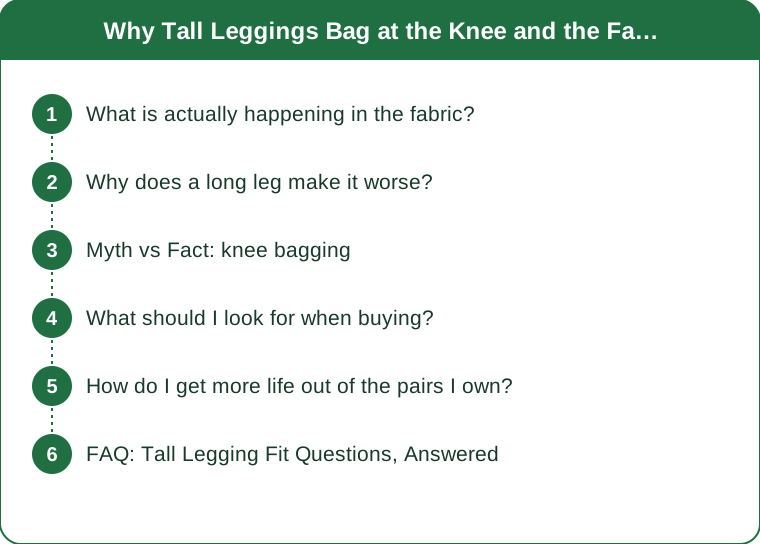
What is actually happening in the fabric?
Every stretch fabric has two properties that get confused with each other.
Stretch is how far it goes. Recovery is how completely it returns. A fabric can have excellent stretch and poor recovery, and that combination produces exactly the garment that feels great in the changing room and bags out by lunch.
Recovery comes almost entirely from the elastane, the spandex or Lycra component. Nylon and polyester provide the structure and the hand, but they do not spring back on their own. When elastane is stretched repeatedly without rest, it recovers a little less each time, and the deficit accumulates over the day.
The knee is where this hits hardest. Walking flexes it thousands of times. Sitting holds it at maximum stretch for long periods, which is worse than repeated movement, because sustained tension causes more permanent set than cyclic tension does.
Body heat accelerates all of it. Elastane softens as it warms, so a warm knee is a knee where the fabric recovers less.
Why does a long leg make it worse?
Three compounding reasons, and none of them are about your body being unusual.
More panel length above and below the joint. A tall legging has a longer thigh and calf section. Stretch that occurs at the knee has more fabric to redistribute into, so the deformation spreads and becomes a visible pouch rather than a tight line.
More fabric weight hanging below the knee. A longer calf section is more grams of fabric pulling downward on the knee area all day. It is not a large force, but it is constant, and constant is exactly what causes permanent set.
Tall sizing is often a scaled standard rather than a redraft. Many brands produce tall sizes by lengthening panels proportionally without changing the fabric spec or adding knee reinforcement. The garment is longer but not stronger, so the same fabric is being asked to do more work.
There is also a fit factor. If tall leggings are slightly short on you, as they frequently are, the knee sits below your actual knee joint and the fabric is under tension at that point from the moment you put them on.
Myth vs Fact: knee bagging
Myth: It means you bought the wrong size. Fact: Size affects it at the margins. A pair that is too large bags sooner because there is slack to collect, but a correctly sized pair in a low-recovery fabric bags too. Fabric composition predicts this far better than size does.
Myth: Expensive leggings do not do it. Fact: Price correlates loosely with elastane content and knit density, so expensive pairs often do better, but plenty of expensive leggings are 12 percent elastane in a light knit and bag on schedule.
Myth: Once they bag, they are finished. Fact: Most bagging is temporary. A cool wash and a full air dry restores a large part of it, because elastane recovers with rest and cooling. Permanent set only accumulates after many cycles, or after heat damage.
Myth: The dryer helps them shrink back. Fact: The dryer is the fastest way to make it permanent. Heat degrades elastane, and once those fibres are damaged they do not recover at all. This is the single most common cause of a pair going from occasionally baggy to always baggy.
Myth: Squat-proof means bag-proof. Fact: Different tests. Squat-proof measures opacity at maximum stretch. It says nothing about whether the fabric returns to shape afterwards.

What should I look for when buying?
Four specifications, in order of how much they predict.
Elastane content of 20 percent or more. This is the strongest single indicator. Many mainstream leggings sit at 12 to 18 percent. Moving to 20 to 28 percent makes a visible difference to how a pair looks at 4pm. Look for it in the fabric composition rather than in the description.
Fabric weight above roughly 250 grams per square metre. Heavier knits hold shape better, full stop. Light buttery fabrics feel wonderful and bag faster. Not every brand publishes weight, and those that do are usually the ones with something to show.
Nylon-based rather than polyester-based, where you have the choice. Nylon knits generally recover better and feel denser at the same weight, though they hold odour more, which is a genuine trade-off.
Seaming at or around the knee. A panelled or contoured knee, common in running and cycling designs, mechanically limits how far the fabric can deform at that point. It is uncommon in fashion-leaning leggings and very effective.
Is compression the same as recovery?
No. Compression describes how much pressure the garment applies. A high-compression pair with poor recovery still bags, it just takes slightly longer.
How do I get more life out of the pairs I own?
Care is doing most of the work here, and it is largely free.
- Wash cold, inside out, on a gentle cycle. Heat is the enemy of elastane and hot water does the damage even before the dryer gets a chance.
- Never use the dryer. Air dry flat or on a hanger. This one change extends the useful life of a pair more than anything else on this list.
- No fabric softener. It coats the fibres and interferes with elastane recovery directly.
- Rotate pairs. Elastane genuinely benefits from 24 to 48 hours of rest between wears. Three pairs rotated will each outlast one pair worn constantly, by more than the arithmetic suggests.
- Do not fold them along the knee crease for storage. Roll them instead. A permanent storage crease at exactly the point that already gets the most stress is an unnecessary head start.
And the immediate fix for a pair that has bagged today: wash cold and air dry. In most cases they come back close to new. If they do not, the elastane is damaged and no amount of care will recover it, which is genuinely the end of that pair.
FAQ: Tall Legging Fit Questions, Answered
Does this get worse after 40?
The fabric does not know your age. What often changes is the rotation, since people tend to settle on two or three favourite pairs and wear them harder, and that concentration of wear accelerates bagging noticeably.
Should I size down to prevent it?
No. A pair that is too tight is under higher constant tension, which increases permanent set rather than reducing it, and it is uncomfortable. Fit correctly and buy for recovery.
Do 7/8 lengths bag less than full length?
Slightly, because there is less fabric weight below the knee. If you like the length anyway, it is a small free improvement.
Is knee bagging covered by a warranty?
Occasionally, under a general quality guarantee, if it happens within weeks rather than months. It is worth contacting the brand if a new pair bags badly on first wear, because that usually indicates a fabric batch problem rather than normal wear.
TL;DR:
- Knee bagging is a recovery problem, not a stretch or size problem. The elastane is not springing all the way back.
- A tall leg makes it worse through longer panels, more fabric weight below the knee, and tall sizes that lengthen without upgrading the fabric.
- Buy for 20 percent or more elastane, a knit above roughly 250gsm, and a nylon base.
- Never use the dryer, skip softener, rotate pairs, and roll rather than fold.
Most bagging you see at 4pm is temporary and a cold wash undoes it. The pairs that stay baggy are almost always pairs that met a hot dryer, and that is the one mistake worth eliminating completely.
See It in Motion
Seen here: High Waist Yoga Leggings with Side Pockets — shop it on bubblelime.com
Keep Reading
This article is for general informational and styling purposes only. Fit, sizing, and product availability may vary.