Your Inseam Did Not Change After 40. Your Waistband Did.
Quick Answer: If long pants started hitting above your ankle in your forties without your height changing, the cause is almost always rise, not inseam. A waistband that sits an inch lower on the body pulls the hem up an inch. Torso shape shifts with age, low-rise waistbands migrate down, and the hem pays for it.
You have bought the same tall size for fifteen years. Same brand, same length, and now it grazes the ankle bone instead of covering it. Nothing about your legs changed. Something about where the pants stop did.

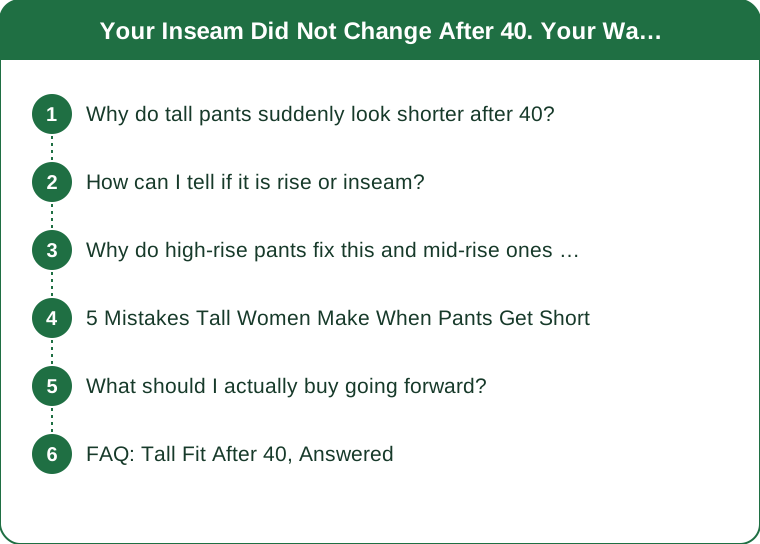
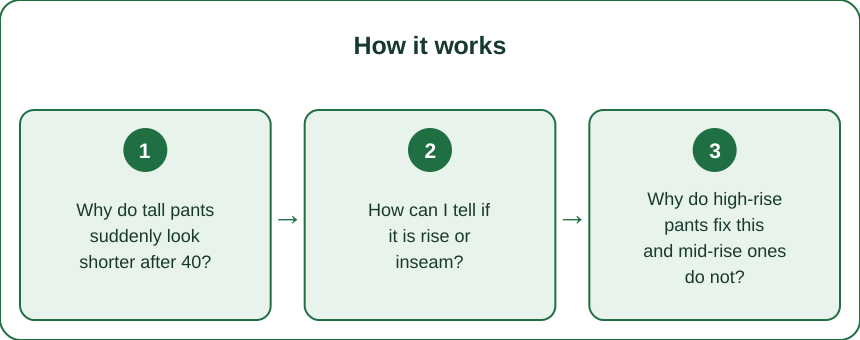
Why do tall pants suddenly look shorter after 40?
Inseam is measured from crotch seam to hem. It is a fixed number printed on a tag. What is not fixed is where the crotch seam ends up sitting on your body.
After forty, most women see some redistribution around the midsection along with a small loss of spinal height. A waistband that once sat at the natural waist now sits half an inch to an inch lower, because there is more circumference at the point where it used to grip.
Drop the waistband an inch and the crotch seam drops with it. The hem follows. Your 34-inch inseam is still 34 inches; it just started an inch lower, so it ends an inch higher relative to your ankle.
How can I tell if it is rise or inseam?
Take a two-minute measurement instead of guessing.
- Stand in front of a mirror in the pants and mark where the top of the waistband sits relative to your navel
- Compare to a pair from a few years ago that still fits right
- If the old pair sits higher, you have a rise problem
The tell is usually obvious once you look. If the waistband on the newer pair is sitting below the navel and the older one sits at or above it, you found your inch.
A second tell: if the pants also feel like they need pulling up during the day, that is a rise and grip issue. Genuinely short pants do not migrate.
Why do high-rise pants fix this and mid-rise ones do not?
A high rise anchors above the widest part of the midsection instead of on it. Anything that sits on a curve slides down it; anything that sits above a curve stays put.
That is the entire mechanism. A 12-inch rise on a tall frame has something to hold onto. A 9-inch rise has to grip a slope and it loses that argument every time you sit down.
For tall women this compounds, because a long torso means a mid rise on a tall body is functionally a low rise. The same 10-inch rise that hits a 5’4” frame at the natural waist hits a 5’11” frame three inches below it.

5 Mistakes Tall Women Make When Pants Get Short
1. Sizing up. More circumference does not add length, and a looser waistband slides down faster, which makes the hem problem worse.
2. Buying extra-tall when regular tall would work. If the issue is rise, extra-tall gives you dragging hems in the correct-rise pairs and still-short hems in the wrong-rise ones.
3. Assuming the brand changed. Sometimes true, often not. Check your own measurement before writing off a brand you like.
4. Ignoring the waistband width. A 2-inch band grips less than a 4-inch band at the same rise. Wide bands distribute pressure and migrate less.
5. Only checking the fit standing still. Sit down, stand up, walk ten steps, then look. The hem position after movement is the real hem position, and this is the mistake that surprises even people who measure carefully.
What should I actually buy going forward?
Shop the rise number first and the inseam second. Most tall lines print both if you look at the size chart rather than the product title.
For a 5’10” to 6’1” frame, a rise of 11.5 to 13 inches paired with a 3.5 to 4 inch waistband holds position all day. Below 11 inches you are fighting gravity.
Also favor fabrics with a firmer hand at the waistband, even if the leg is soft. A soft band on a firm leg is the exact combination that migrates. Late summer into fall is a good time to reset the rotation, since fall bottoms hit shelves now and you can measure before the size you need sells out.
FAQ: Tall Fit After 40, Answered
Do I really lose height in my forties?
Measurable height loss usually starts later, typically after 50, and it is small, around a quarter inch per decade. It is rarely the cause of a full inch of hem change in your forties.
Will hemming solve this?
No, and it makes things worse if the rise is the real problem. You would be shortening a pant that is already sitting too low.
Is a longer torso or longer legs more common in tall women?
Both exist, and it changes what you should buy. Sit on a hard chair and measure from seat to shoulder. Above 24 inches means long torso, which means you need the higher rise even more.
TL;DR:
- Inseam is fixed; the hem moves because the waistband moved
- After 40, midsection changes drop a mid-rise waistband an inch, taking the hem with it
- A rise of 11.5-13 inches with a 3.5-4 inch band solves it for most tall frames
- Test fit after sitting and walking, not standing still
Measure where your waistband sits on an old pair that still works, then shop that rise number. It turns a frustrating guessing game into a spec you can filter by, and it stops you from buying extra-tall sizes to solve a problem that lives six inches higher up.
Keep Reading
This article is for general informational and styling purposes only. Fit, sizing, and product availability may vary.