Why Shoulder Fit, Not Length, Becomes the Real Sizing Challenge for Tall Women After 40
Quick Answer: For many tall women, shoulder and upper-back fit becomes the dominant sizing challenge after 40 as postural changes (a more pronounced thoracic curve, some loss of shoulder mobility) shift where a garment’s shoulder seam and armhole need to sit — sizing that solved for inseam length in earlier decades often stops accounting for this upper-body shift, which is why tops and jackets start feeling tight across the back even when the length is still correct.
For decades the tall-woman sizing conversation has centered almost entirely on inseam and torso length, and then somewhere in the 40s a completely different fit problem shows up: the shoulders.

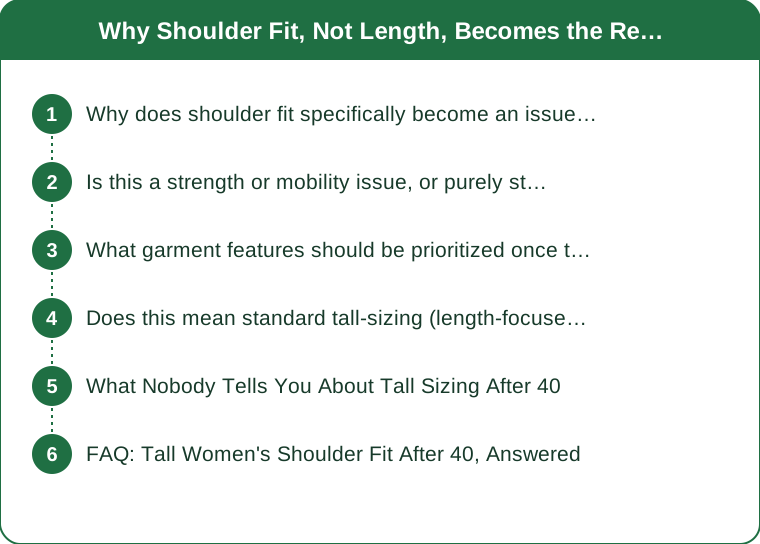
Why does shoulder fit specifically become an issue later, when length was always the main concern before?
Postural shifts that become more common with age — a slightly more pronounced thoracic curve, some reduction in shoulder external rotation — change the actual three-dimensional shape the shoulder and upper back present to a garment. A shoulder seam and armhole cut for a younger, more neutral posture can start to feel tight or restrictive across the back even though the wearer’s overall height and arm length haven’t changed at all.
Is this a strength or mobility issue, or purely structural aging?
It’s usually a mix — reduced thoracic spine mobility and some natural postural rounding are common enough with age that they affect a large share of women, independent of overall fitness level, though staying strong and mobile in the upper back can meaningfully slow or reduce the degree of change. Either way, the practical fit consequence is the same: the shoulder area needs slightly more room and a different seam placement than tall-sizing charts, which were largely designed around length, typically account for.
What garment features should be prioritized once this shift starts happening?
A slightly dropped or raglan shoulder seam, rather than a fitted set-in sleeve, generally accommodates a changing thoracic curve more comfortably, since it doesn’t rely on the seam landing at one precise pivot point. Four-way stretch fabric through the upper back and shoulder, not just through the torso and legs, also makes a meaningfully bigger difference for tall women in this stage than it did in earlier decades of shopping.

Does this mean standard tall-sizing (length-focused) becomes less useful after 40?
Not less useful, but incomplete on its own — length sizing still solves the inseam and torso-length problem tall women have always faced, but it needs to be paired with attention to shoulder and back room specifically, which most tall-focused size charts don’t separately call out. Reading garment reviews specifically for shoulder or upper-back fit comments becomes a genuinely useful extra step that wasn’t as necessary in earlier decades.
What Nobody Tells You About Tall Sizing After 40
A jacket or top that fit perfectly in a brand’s tall size five years ago can start feeling tight across the shoulders in the identical size today, even without any weight change — this is one of the more confusing and under-discussed fit shifts tall women report, precisely because it isn’t driven by size but by posture and mobility changes the sizing system was never designed to track.
FAQ: Tall Women’s Shoulder Fit After 40, Answered
Are there specific brands known for handling this shoulder shift better?
Brands offering athletic or performance-cut tall sizing, which tend to build in more four-way stretch and dropped-shoulder construction, generally accommodate this shift better than traditional tall-length-only sizing lines.
Can upper-back mobility work actually help with this fit issue?
Some, yes — maintaining thoracic mobility and shoulder external rotation through regular mobility work can slow the degree of postural shift, though it won’t fully prevent the natural changes that come with age.
Is a size-up the right fix for shoulder tightness, or does that just create length problems elsewhere?
Sizing up specifically to fix shoulder tightness often does create excess length or looseness elsewhere on a tall frame — prioritizing garments with stretch and dropped-shoulder construction in the correct length size is usually a better fix than sizing up overall.
TL;DR:
- Postural and mobility changes after 40 shift how the shoulder and upper back interact with a garment’s fit
- This is a separate problem from the length issue tall sizing has traditionally solved for
- Dropped-shoulder cuts and four-way stretch through the back help accommodate the shift
- Sizing up to fix shoulder tightness often creates new length problems — the cut matters more than the size
Tall sizing solved the length problem tall women have dealt with for decades — the shoulder shift after 40 is a newer, less-discussed fit challenge that needs its own set of fixes, not just a bigger size.
Keep Reading
This article is for general informational and styling purposes only. Fit, sizing, and product availability may vary.