Why Sports Bra Bands Ride Up on Tall Torsos After 40
Quick Answer: A band rides up when it lacks the tension to stay anchored under the bust, and it takes the path of least resistance - upward, over the ribcage taper. On a long torso the same band sits proportionally lower relative to strap length, which increases upward pull. After 40, ribcage width often increases while breast tissue softens, so a band that used to be snug is now loose in exactly the direction that matters. Size down the band, size up the cup.
The band does 80 percent of the support work. If it moves, nothing else can compensate.

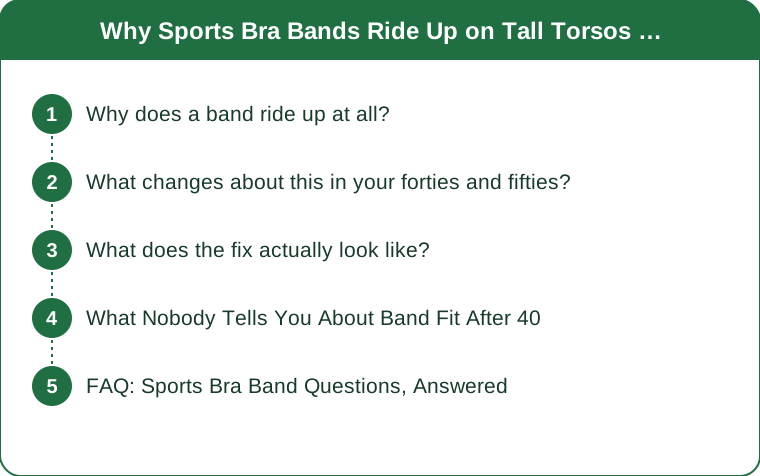
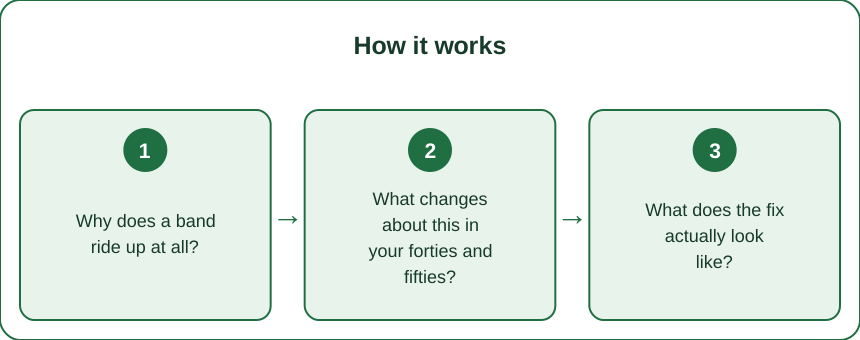
Why does a band ride up at all?
Because a band is a tension ring around a cone, and a cone with insufficient tension slides toward the narrow end.
Your ribcage is not a cylinder. It tapers inward as it goes up toward the sternum and outward as it goes down toward the base of the ribs. A firm band sitting at the underbust is wedged at the widest point of that section, and it stays. A loose band has nowhere stable to sit, and every time you raise your arms - which is constantly, in almost any workout - the straps pull the whole garment upward and the band follows.
The physics of the fix: band tension has to exceed the upward force from the straps. When it does not, the garment migrates. This is why tightening the straps makes riding up worse rather than better, which is the single most common mistake people make with a bra that is riding up. Tighter straps increase the upward force. The band is the thing that needs to change.
A properly fitted band should:
- Sit level all the way around, front and back at the same height
- Stay put when you raise both arms overhead - test this in the fitting room, since it is a two second check that predicts everything
- Allow two fingers under it at most, snug enough that it does not shift
- Hold when the straps are loosened - if it cannot support without strap tension, it is too big
On a long torso, all of this is harder to achieve because the strap run from band to shoulder to band is longer. More strap length means more leverage acting to lift the band, so a long torso needs a proportionally firmer band to stay anchored - not the same band tension a shorter torso would tolerate.
What changes about this in your forties and fifties?
Three things shift at once, and they compound.
Ribcage circumference tends to increase. Some of this is redistribution of body composition, some is postural change, and some is the natural widening of the lower ribcage that happens with age and with pregnancy history. An inch of increase at the underbust is enough to take a band from snug to loose, and it usually happens slowly enough that nobody notices the point at which the bra stopped working.
Breast tissue composition changes. Glandular tissue is gradually replaced by fatty tissue through the perimenopausal transition. Fatty tissue is softer and moves more under impact, which means the same band is now managing more movement than it was designed for. Support requirements go up while band tension goes down - the worst possible combination.
Postural changes alter strap geometry. Increased thoracic rounding, which is extremely common and largely reversible with training, brings the shoulders forward and changes the angle at which straps pull. A more forward strap angle increases the upward component of the force on the back of the band. That is why riding up is often noticeably worse at the back than the front.
The practical consequence: the band size you wore at 35 is very likely wrong at 50, and the direction of the error is almost always the same - band too big, cup too small. Most people respond to a bra that feels inadequate by sizing up overall, which makes the band problem worse while fixing nothing.
Re-measure annually. It takes three minutes and it is the single highest-value thing to do about this. Measure the underbust snugly with the tape level, exhale fully, and use that number rather than the one you remember.

What does the fix actually look like?
Sister sizing, then style selection.
Step one - go down a band and up a cup. If a 36C rides up, try 34D. The cup volume is nearly identical - that is what sister sizing means - but the band is firmer and will stay put. If 34D still rides up, try 32DD. People are consistently surprised by how small the band number needs to be, and equally surprised that the cup letter climbing does not mean their breasts got bigger. It means the volume is now expressed against a smaller band.
Step two - check hook position. A new bra should fit on the loosest hook, so you have two tighter settings to move to as the elastic relaxes over months. If you are buying something that only fits on the tightest hook, it is already too big.
Step three - choose styles that suit a long torso.
- Wide bands, 2 inches or more, distribute pressure and resist rolling far better than narrow elastic
- Longline styles cover more ribcage and have more surface friction, so they migrate less. They are also the most reliable option for a long torso by a wide margin.
- Encapsulation over pure compression for anything above a C cup - separating and supporting each side manages movement better than flattening
- Racerback or convertible straps pull more vertically and less outward, reducing the tendency to slide off the shoulder that pushes people to overtighten
- Avoid thin elastic underbands and avoid crop-style bralettes for impact. Both rely on the band being tight to work, and both stretch out fast.
Step four - replace on schedule. Sports bra elastic loses meaningful tension after roughly 30 to 40 washes. A bra worn twice a week is functionally done inside a year. Riding up that starts suddenly in a bra you have had a while is usually just dead elastic, and no amount of adjustment recovers it.
What Nobody Tells You About Band Fit After 40
The cup letter is meaningless on its own. A D cup on a 32 band and a D cup on a 40 band are completely different volumes. People avoid larger letters for reasons that have no basis in the sizing system, and it directly causes the band-too-big problem.
Most retail fittings still use the plus-four method - adding four inches to your underbust measurement - which was designed for the elastic quality of decades ago and reliably produces a band that is too loose today. If a fitting gives you a number four inches above your actual underbust measurement, treat it as a starting point at best.
A band that leaves a light mark is usually correct. A band that leaves a deep indentation or restricts breathing is too tight. The distinction matters, because fear of the first sends people to a size that cannot support them.
Riding up and shoulder pain are the same problem. When the band is not carrying its share, the straps take the load, and that shows up as trapezius tension and grooving. Fixing the band frequently resolves shoulder discomfort people had attributed to posture or training.
Long torso is why swimwear and bodysuits have always felt short on you. It is the same measurement causing the same issue in a different garment, and brands that offer explicit long-torso options in swim often run longer in bras too.
Two bras rotated last longer than one worn constantly. Elastic needs recovery time between wears, and alternating genuinely extends usable life by months.
FAQ: Sports Bra Band Questions, Answered
Will tightening the straps stop the riding up?
No - it makes it worse. Straps pull upward; the band is what resists that. Tightening straps increases the force that is lifting the band in the first place.
How do I measure my band size correctly?
Wrap the tape snugly and level around your ribcage directly under the bust, exhale fully, and read the number. Use that number as the band size. Do not add four inches.
Is a longline bra always better for a long torso?
Usually, yes. More coverage means more friction against skin and a wider surface distributing tension, both of which resist migration. The trade-off is heat, which matters more in summer.
How often should I replace a sports bra?
Every 30 to 40 washes, or roughly annually for something worn twice a week. Elastic fatigue is invisible until the support is already gone.
My band fits but the cup gapes at the top - what is that?
Usually a shape mismatch rather than a size one. Try a different cup style before changing size, and check whether you are scooping tissue fully forward into the cup when you put it on.
TL;DR:
- A band rides up because it lacks tension, and long torsos need more band tension because longer straps create more upward leverage.
- After 40, ribcage width often increases while tissue softens - the band gets looser exactly as support needs rise.
- Fix it with sister sizing: down a band, up a cup. New bras should fit on the loosest hook.
- Wide bands, longline styles, and encapsulation outperform thin-band compression crops for long torsos.
- Replace every 30 to 40 washes. Sudden riding up in an older bra is usually dead elastic.
Re-measure your underbust this week. Most people are wearing a band two sizes too big.
See It in Motion
Seen here: Round Neck Long Sleeve Athletic T-Shirt — shop it on bubblelime.com
Keep Reading
This article is for general informational and styling purposes only. Fit, sizing, and product availability may vary.