Why Tall Women's Clothes Fit Worse in Your Fifties Than Your Thirties
Quick Answer: Tall clothing fits differently after 45 because torso-to-leg proportion shifts slightly with spinal compression, weight distribution moves toward the midsection, and shoulder posture changes — while tall sizing charts still assume a 30-year-old’s proportions. The fixes are prioritizing rise height over inseam, choosing structured shoulders, and buying for the torso first.
You have been tall your whole life. You know your inseam. You know which brands run short.
And yet somewhere in the last few years, the same size in the same brand started sitting wrong in a way you cannot quite name.
Nothing about your height changed. What changed is the set of assumptions built into tall sizing — and they were never designed to hold up across four decades.

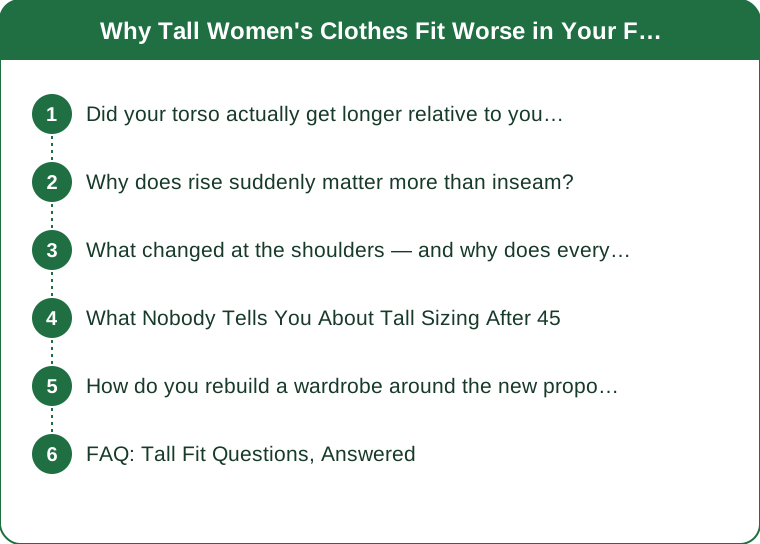
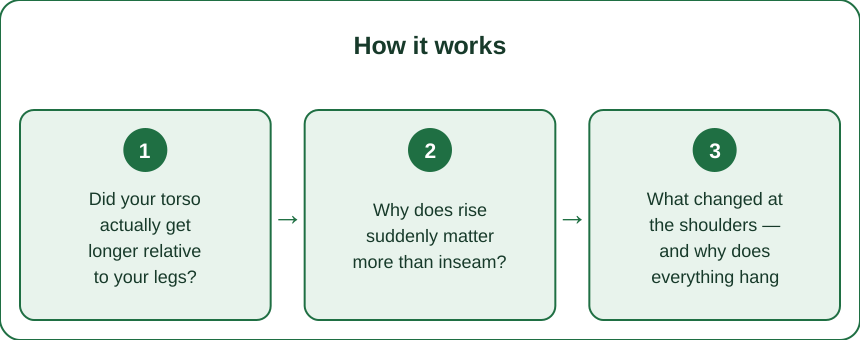
Did your torso actually get longer relative to your legs?
Slightly, and it is measurable.
Spinal disc compression reduces standing height by roughly half an inch to an inch between 40 and 60 for most people, and it comes almost entirely out of the torso, not the legs. Meanwhile, the pelvis often tilts marginally as hip flexors tighten from years of sitting.
The net effect: your leg length stays essentially constant while your effective torso proportion shifts. A tall top drafted for a 5’10” thirty-year-old assumes a specific shoulder-to-hip measurement, and yours is now a fraction different.
That fraction is enough to move a waist seam off your natural waist, which is where “this fits but looks wrong” comes from.
What to do about it: measure your actual torso from the top of the shoulder to your natural waist, once, and write it down. Then compare it to the brand’s stated tall measurements rather than trusting the label. Many tall lines publish this and almost nobody reads it.
Why does rise suddenly matter more than inseam?
Because the waist is where midlife body change concentrates, and tall sizing barely accounts for it.
Tall pant sizing is built around one variable: inseam. Brands extend the leg and often leave the rise nearly unchanged, or add a token half inch. The result is that a tall woman with a longer torso gets pants that are correctly long and incorrectly low.
Then add the typical shift in weight distribution toward the midsection after 45, and a rise that used to sit at the natural waist now sits below the fullest part — which is the least comfortable and least flattering placement possible.
Practical priorities that reverse the usual order:
- Buy for rise first, hem second. A hem can be altered for $15. A rise essentially cannot.
- Look for stated rise measurements of 11 inches or more in tall activewear, versus the 9 to 10 common in regular sizing.
- Test by sitting down in the fitting room. Standing rise tells you very little. If the waistband slides down when you sit, it will do that all day.
What changed at the shoulders — and why does everything hang differently?
Shoulder posture shifts forward gradually, and tall garments are especially sensitive to it because they have more length hanging below.
As the upper back rounds slightly — near-universal after decades of desks, driving, and phones — the front hem of a top rises and the back hem drops. On a shorter person this is barely visible. On a tall frame with a longer garment, the diagonal is obvious.
That is why tops that used to hang straight now look like they are pulling up in front, and why you keep tugging at them.
Three responses that work:
- Choose structured shoulders over drapey ones. A defined shoulder seam holds the garment’s geometry against posture; a dropped or dolman shoulder follows your posture and amplifies it.
- Prefer curved or slightly longer back hems in tops. Some brands draft this deliberately, and it directly corrects the diagonal.
- Do the actual postural work. Thoracic extension and upper-back strengthening move the needle here more than any garment. This is one of the rare fit problems with a non-shopping solution.
This is general information, not medical advice.

What Nobody Tells You About Tall Sizing After 45
Tall lines are drafted from a single fit model, usually in her twenties. Every measurement in that size run is proportional to one specific young body, extended mathematically. The extension math holds for length and breaks down for everything else.
Petite lines often fit tall midlife torsos better in the top half. Sizing up in a petite top gives you a shorter torso length with a fuller cut, which occasionally solves the diagonal-hem problem better than a tall top does. It feels backwards and it works often enough to try.
The seam that matters most is the armhole, not the hem. Tall lines lengthen the body of a top but frequently leave the armhole depth unchanged, which produces the tight-under-the-arm feeling that gets misdiagnosed as needing a bigger size.
Your inseam preference probably should have changed. Full-length leggings drafted for a 5’10” frame in your thirties assumed you would wear low sneakers. If your shoe choices changed, your ideal inseam did too, and most people never revisit the number they memorized decades ago.
Two brands with identical stated tall measurements can fit completely differently based on where they place the knee point. A legging with a knee seam an inch too high creates pulling that never resolves, and no chart mentions it.
How do you rebuild a wardrobe around the new proportions?
Start with measurements, not shopping. One afternoon with a tape measure saves a year of returns.
Record five numbers: shoulder to natural waist, natural waist to floor, inseam, natural waist circumference at its actual location, and hip at the fullest point. Keep them in your phone.
Then apply them in this order:
- Bottoms: rise first, inseam second, everything else third. Alter hems freely.
- Tops: shoulder seam placement and armhole depth first, length second.
- Layers: structured over drapey, especially anything worn open. An open jacket with a defined shoulder does more for a tall frame than any top underneath it.
Re-measure every two years. Proportions genuinely shift, and shopping from numbers you wrote down in 2019 is how people end up with a closet that fits nobody.
The reframe worth making: this is not your body failing to match clothes. It is a sizing system built on a single young template being asked to do something it was never designed for. Adjusting your criteria is the reasonable response.
FAQ: Tall Fit Questions, Answered
Should I switch to regular sizing with alterations?
Often yes for tops, rarely for pants. A regular top sized up and hemmed can fit a tall midlife torso well. Pants are harder because the knee point placement cannot be altered and it is what makes a leg look right.
Is tailoring worth it on activewear?
Hemming leggings is cheap and effective. Taking in a waistband on technical fabric is difficult and usually not worth it. For knit tops, a good tailor can shorten and reshape a hem for very little, and that one change fixes the front-rising problem on garments you already own.
Why do some tall brands fit me and others do not, at the same stated measurements?
Knee point and armhole depth, almost always. Two brands can list the same inseam and place the knee an inch apart. Once you find a brand whose draft matches your proportions, buying repeats from it is a reasonable strategy.
TL;DR:
- Torso proportion shifts with spinal compression while leg length holds — that mismatch is most of the problem.
- Buy bottoms for rise first, inseam second. Hems alter cheaply; rises do not.
- Structured shoulders and curved back hems correct the front-rising diagonal.
- Armhole depth, not overall length, causes most “needs a bigger size” errors in tall tops.
- Re-measure every two years and shop from current numbers, not remembered ones.
The genuinely useful shift is treating this as a data problem rather than a body problem. Five measurements, updated occasionally, turn a frustrating category into a manageable one.
See It in Motion
Seen here: High Waist Yoga Leggings with Side Pockets — shop it on bubblelime.com
Keep Reading
This article is for general informational and styling purposes only. Fit, sizing, and product availability may vary.