Why Wide-Leg Pants Work So Well for Tall Women Over 45 — and How to Get the Fit Right
Quick Answer: Wide-leg pants flatter tall frames because the silhouette needs vertical length to drape properly — the very thing petite shoppers fight is the thing you supply for free. For tall women over 45 the fit checklist is: a high rise that sits at the natural waist, an inseam long enough that the hem hovers within an inch of the floor in your chosen shoes, fabric with enough weight to fall straight, and a fitted or tucked top to anchor the volume. Get those four right and the look does more for you than any skinny silhouette has in years.
Tall women spend decades hearing what they cannot wear, then wide legs come back and the entire logic flips. On a 5’10” frame, a wide-leg pant does what it does on a runway — because runway models are built like you. The over-45 part is not a complication; it is mostly a fabric and rise question, and both have clean answers.

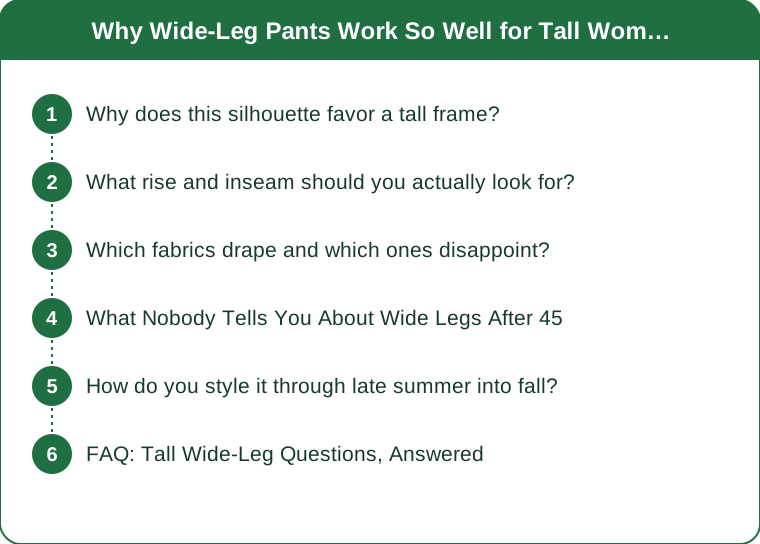
Why does this silhouette favor a tall frame?
Because drape needs distance.
A wide-leg pant creates its effect through an unbroken column of fabric falling from hip to floor. The longer that column, the more gravity can straighten it and the more dramatic the line. On a long leg, the fabric has room to fall, swing, and settle. On a shorter leg the same pant runs out of runway — which is why petite guides are full of hemming advice and tall guides barely need to exist.
There is a proportion effect too. Volume balances height. Very slim pants on a very tall frame can read as more vertical than the eye expects, all line and no weight. A wide leg adds horizontal presence that sits in proportion to your length, which is why the look reads so composed on tall bodies.
And there is a comfort dividend nobody mentions: wide legs do not negotiate with calves, ankles, or the exact placement of a knee the way fitted styles do. For anyone whose relationship with skinny fits changed over the years, the silhouette removes the argument entirely.
The one genuine risk on a tall frame is too much volume with no anchor — a wide pant and an oversized top together can read as fabric wearing a person. The fix lives in the styling section, and it is one rule long.
What rise and inseam should you actually look for?
Rise: high, sitting at your natural waist. A wide leg hung from the hips loses its geometry — the flare starts too low and the proportion collapses. The natural waist is the anchor point the silhouette is drafted around. After 45 this is also simply the comfortable answer: a proper high rise on a long torso holds without digging the way a mid rise parked on the wrong spot does.
One caution from the tall side: some brands achieve “high rise” by stretching the same pattern upward without re-grading, producing a rise that gaps at the back on long torsos. If you know your shoulder-to-waist measurement runs long, look for brands that list rise in inches and compare against a pair you love.
Inseam: longer than your instinct says. Wide legs are worn long — the hem should hover between half an inch and one inch off the floor in the shoe you intend to wear. For a tall woman that regularly means a 33 to 36 inch inseam, which rules out a lot of standard ranges and makes tall-specific lines worth the search. The old tall-girl reflex of accepting ankle-grazing “close enough” undoes this particular silhouette; cropped wide legs are a different, boxier look entirely.
Decide the shoe first, then the inseam. A flat and a two-inch heel need different hems, and no single pair serves both perfectly.
Which fabrics drape and which ones disappoint?
Weight is the whole story. A wide leg lives or dies on whether the fabric falls in a straight, heavy line or collapses against the leg.
Reliable: mid-weight crepe, which has natural body and resists wrinkles; ponte and heavier knits, which move well and forgive; wool blends and twill for structure in cooler months; heavier linen blends for summer, accepting the rumple as part of the look; and the knit wide-leg — essentially a flowing cousin of wide-leg yoga pants — which has quietly become the best travel and everyday version, with drape from the knit weight and an elastic waist that does not fight a long torso.
Disappointing: thin rayon challis that clings with static the moment humidity drops, stiff lightweight cotton that sticks out rather than falling, and anything so light it flutters with each step. Flutter reads flimsy; swing reads expensive. The difference is grams per square meter, not price.
A quick store test: hold the pant by the waistband at arm’s length and watch the leg. If it hangs dead straight with a little heft, it will do that on your body. If it drifts and folds, it will do that too.
For late summer into fall, a mid-weight knit or crepe covers the transition — light enough for an 85-degree afternoon, substantial enough to work over tights territory when October arrives.

What Nobody Tells You About Wide Legs After 45
The shoe is doing more work than the pant. With the hem hovering near the floor, whatever is underneath mostly vanishes — which means comfort wins with no visual penalty. A supportive sneaker, a cushioned loafer, a low block heel: invisible under the hem, and your feet get to be 45+ in peace. This is the only trouser silhouette where the orthotic-friendly shoe and the elegant line are the same outfit.
The anchor rule is one rule: one fitted thing on top. A tucked tee, a slim fine-gauge knit, a fitted tank under an open shirt — anything that shows where your waist is. Volume below plus definition above is the entire formula, and it works at every size.
Wind exists. A true palazzo in a September gust becomes a sail; a straighter, structured wide leg holds its line. If your life involves school pickups on open pavement or a ferry commute, weight and cut are practical decisions, not just aesthetic ones.
And the quiet one: wide legs solve the sock gap. Decades of trousers going flood-length when you sit, flashing ankle and sock — a properly hemmed wide leg pools that extra length invisibly when seated. The small daily indignity of being tall in pants simply stops happening.
What they do demand is hem maintenance. A long hem meets sidewalks, escalators, and heels. Check it monthly; a fraying wide-leg hem un-does the polish faster than anything.
How do you style it through late summer into fall?
Run the season in three moves.
Now, in the heat: linen-blend or knit wide legs, a fitted ribbed tank tucked in, flat sandals or slim sneakers. This is the errand-and-lunch uniform that beats a sundress for anything involving reaching, bending, or car seats. On athleisure days, the same geometry works in performance fabric — a flared or wide-leg yoga pant with a compact bra top reads intentional, not sloppy, precisely because of the volume-plus-anchor rule.
The transition weeks: add a third piece with shoulders — a cropped or hip-length jacket, a fine knit tied on. Keep the jacket shorter than your usual instinct; a long duster over a long wide leg stacks two columns and swallows the waist you anchored. Hip-length over high rise is the reliable proportion on a tall frame.
First cold weeks: swap the linen for crepe or ponte, the sandal for a loafer or boot with a modest heel — remembering the hem was set for a specific shoe height. This is the argument for owning two hems: one pair finished for flats, one for the fall boot.
Color strategy stays simple: a column of one color, top and bottom in the same family, is the tall frame’s easiest elegance. You have the length to make monochrome look deliberate; most people have to fake it.
FAQ: Tall Wide-Leg Questions, Answered
Are wide-leg pants still in style, or am I late to this?
The silhouette has been dominant for several years and has settled into wardrobe-staple territory rather than trend territory. For tall frames it never really left — it predates the trend cycle and will outlast it, the way it did in every previous decade it appeared.
I am tall and curvy — does the formula change?
Only the fabric weight. Curves under thin fabric show every line; mid-weight crepe and ponte skim instead of cling. The high rise at the natural waist matters even more, and a slight A-shape through the hip beats a straight-cut waistband. The fitted-top anchor rule is identical.
Can I wear wide legs to work out, or is that just a fashion cut?
The flared and wide-leg yoga pants category is exactly this silhouette in performance fabric, and it handles studio classes, walking, and travel days well. For anything with lateral movement or machinery, keep the hem at ankle-bone height rather than floor-hover — the elegance rule yields to the not-stepping-on-your-hem rule.
What tops work if I never tuck anything in?
A fitted top that ends at the high hip does the anchoring without a tuck — think slim fine-gauge knits or a structured tee with a clean hem. What undoes the look is volume on volume: an untucked, oversized shirt over a full wide leg loses the waist entirely. If oversized is the mood, add a belt or choose the straighter, less voluminous wide-leg cut.
TL;DR:
- Wide legs need vertical length to drape — tall frames supply what the silhouette demands, no hemming compromises required.
- Fit checklist: high rise at the natural waist, hem hovering within an inch of the floor in the chosen shoe, fabric heavy enough to fall straight.
- Style rule is one line long: volume below, one fitted thing above. Hip-length outer layers, not dusters.
- Comfortable shoes vanish under the hem — the rare silhouette where foot comfort after 45 costs nothing visually.
Pick one pair in a mid-weight knit or crepe, hem it for the shoes you actually live in, and wear it through the next month. It will out-earn everything else on the rail by September.
See It in Motion
Seen here: Super High Waist Embossed Yoga Leggings with Inner Pocket — shop it on bubblelime.com
Keep Reading
This article is for general informational and styling purposes only. Fit, sizing, and product availability may vary.